Use Case 4 · WP6 — Migraine Care

A forehead test

that guides migraine treatment
Migraine is the biggest cause of disability in people under 50 — yet diagnosis is often delayed, and care remains fragmented between GPs and specialists. H@H builds a decentralised, digitally supported pathway that helps get patients to the right care, faster.

What H@H is doing

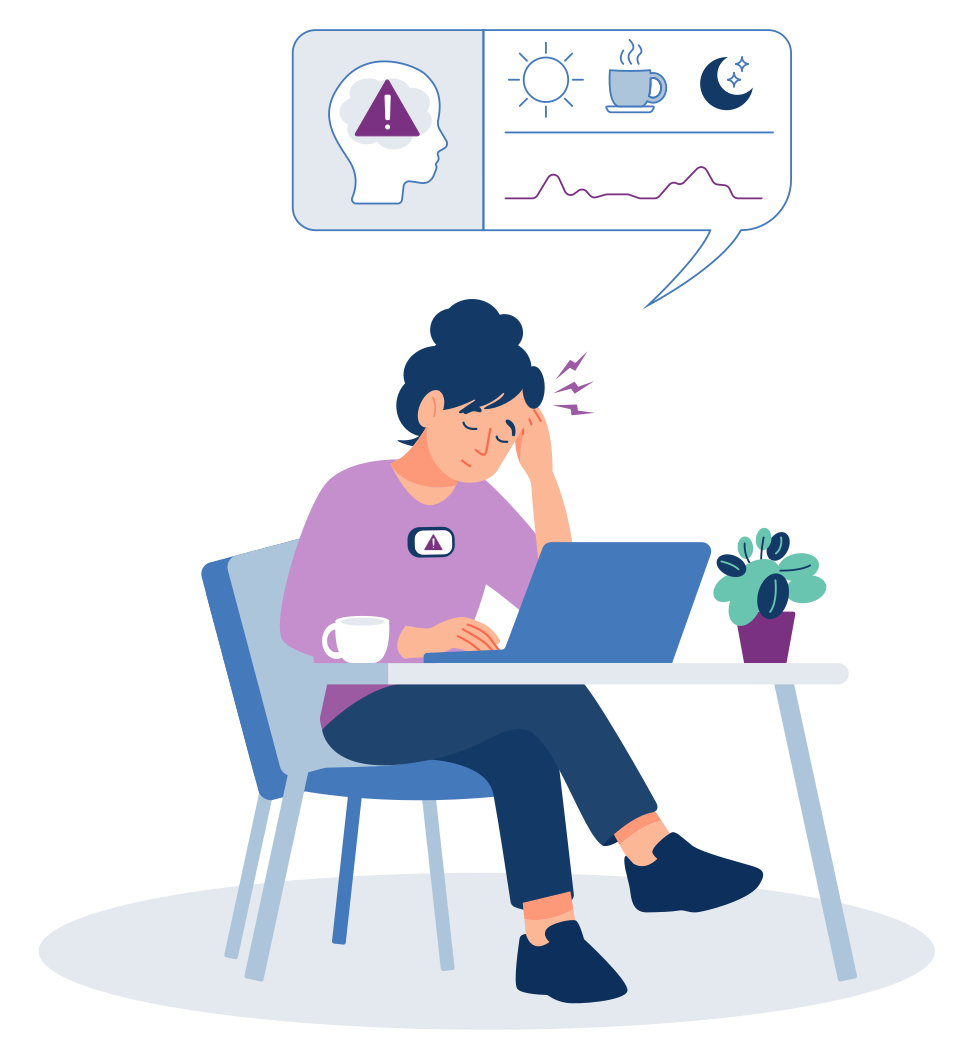
Patients use wearables and a headache diary to track physiological signals — heart rate, activity, temperature, stress markers — alongside patient-reported outcomes. An AI model learns to recognise the early warning signs of an oncoming attack, in some cases hours before it begins, and alerts the patient to start treatment in time. For patients who don’t respond to medication, an ultra-thin implantable neurostimulator can be triggered to intervene automatically.

Heart rate
Heart rate
Temperature
Temperature
Oxygen levels
Oxygen levels
Activity
Activity
Statistics
Patient care

Key innovation

01

A non-invasive forehead test

measures nerve sensitivity
02

Help selecting right candidates

for neurostimulation therapy
03

Turning subjective decisions

into at-home data-backed objective decisions

Expected impact

Earlier warning of attacks

Giving patients time to act

Reduced frequency, duration and intensity of attacks

Helps treatment-resistant patients

Fewer emergency hospital visits

For a condition that is too often left to guesswork

A non-invasive forehead test measures nerve sensitivity to identify who will benefit from neurostimulation. This turns a subjective decision into one backed by objective, at-home data.

Join our newsletter

Don’t miss our latest insights.